Showing posts with label Faith. Show all posts

Tuesday, September 29, 2015

Charles Spurgeon Sermon - A View of God's Glory


A View of God's Glory


A Sermon
(No. 3120)

Delivered by
C. H. SPURGEON,
At New Park Street Chapel, Southwark.


"And he said, I beseech thee, show me thy glory."—Exodus 33:18.
HAT WAS A large request to make. He could not have asked for more: "I beseech thee, show me thy glory." Why, it is the greatest petition that man ever asked of God. It seems to me the greatest stretch of faith that I have either heard or read of. It was great faith which made Abraham go into the plain to offer up intercession for a guilty city like Sodom. It was vast faith which enabled Jacob to grasp the angel; it was mighty faith which enabled Elijah to rend the heavens and fetch down rain from skies which had been like brass before; but it appears to me that this prayer contains a greater amount of faith than all the others put together. It is the greatest request that man could make to God: "I beseech thee, show me thy glory." Had he requested a fiery chariot to whirl him up to heaven; had he asked to cleave the water-floods and drown the chivalry of a nation; had he prayed the Almighty to send fire from heaven to consume whole armies, I could have found a parallel to his prayer; but when he offers this petition, "I beseech thee, show me thy glory," he stands alone, a giant among giants; a Colossus even in those days of mighty men. His request surpasses that of any other man: "I beseech thee, show me thy glory." Among the lofty peaks and summits of man's prayers that rise like mountains to the skies, this is the culminating point; this is the highest elevation that faith ever gained: it is the loftiest place to which the great ambition of faith could climb; it is the topmost pillar of all the towering structures that confidence ever piled. I am astonished that Moses himself should have been bold enough to supplicate so wondrous a favor. Surely after he had uttered the desire, his bones must have trembled, his blood curdled in his veins, and his hair must have stood on end. Did he not wonder at himself? Did he not tremble at his own hardihood? We believe that such would have been the case had not the faith which prompted the prayer sustained him in the review of it.
    Whence, then, came faith like this? How did Moses obtain so eminent a degree of this virtue? Ah, beloved, it was by communion with God. Had he not been for forty days in the council-chamber with his God? Had he not tarried in the secret pavilion of burning fire? Had not Jehovah spoken to him as a man speaketh with his friend, he would not have had courage enough to ask so large a boon. Yea, more, I doubt whether all this communion would have been sufficient if he had not also received a fresh testimony to the grace of God, in sparing a nation through his intercession. Moses had argued with God, he had pleaded the covenant, and although God had said, "Let me alone that I may destroy them," he had still maintained his hold; he had even ventured to say, "If not, blot my name out of the book of life," let me die as well as the rest; he had wrestled hard with justice, and had prevailed. The strength gained by this victory, joined with his former communion with the Lord, made him mighty in prayer; but had he not received grace by these means, I think the petition was too large even for Moses to venture to carry to the throne. Would you, my brethren, have like faith, then walk in the same path. Be much in secret prayer. Hold constant fellowship with the Father, and with his Son Jesus Christ; so shall you soar aloft on wings of confidence, so shall you also open your mouth wide and have it filled with divine favors, and if you do not offer the same request, yet you may have equal faith to that which bade Moses say, "I beseech thee, show me thy glory."
    Allow me to refer you to the 13th verse of this chapter, where Moses speaks unto his God—"Now therefore, I pray thee, if I have found grace in thy sight, show me now thy way." Moses asked a less favor before he requested the greater. He asked to see God's way before he prayed to see his glory. Mark you, my friends, this is the true mode of prayer. Rest not content with past answers, but double your request and go again. Look upon your past petitions as the small end of the wedge opening the way for larger ones. The best way to repay God, and the way he loves best, is to take and ask him ten times as much each time. Nothing pleases God so much as when a sinner comes again very soon with twice as large a petition—"Lord thou didst hear me last time, and now I am come again." Faith is a mighty grace, and always grows upon that which it feeds. When God has heard prayer for one thing, faith comes and asks for two things, and when God has given those two things, faith asks for six. Faith can scale the walls of heaven. She is a giant grace. She takes mountains by their roots, and puts them on other mountains, and so climbs to the throne in confidence with large petitions, knowing that she shall not be refused. We are most of us too slow to go to God. We are not like the beggars who come to the door twenty times if you do not give them anything. But if we have been heard once, we go away, instead of coming time after time, and each time with a larger prayer. Make your petitions longer and longer. Ask for ten, and if God gives them, then for a thousand, and keep going on until at last you will positively get faith enough to ask, if it were proper, as great a favor as Moses did—"I beseech thee, show me thy glory."
    Now, my friends, we have just spoken a word or two on the prayer itself; we shall have to see how it was received at the throne. It was answered, first, by a gracious manifestation; secondly, by a gracious concealment; and, thirdly, by a gracious shielding.
    I. First of all this prayer which Moses offered was heard by God, and he gave him A GRACIOUS MANIFESTATION: "And he said, I will make all my goodness pass before thee; and I will proclaim the name of the Lord before thee; and I will be gracious to whom I will be gracious, and will show mercy on whom I will show mercy."
    I think that, when Moses put up this prayer to God, he was very much like Peter, when, on the mountain top, he wist not what he said. I do think that Moses himself hardly understood the petition that he offered to God. With all the clearness of his ideas; however pure his conception of the divinity might be, I do think that even Moses himself had not adequate views of the Godhead. He did not then know so much of God as he now has learned where he stands before the throne of the Most High. I believe that Moses knew that God is a Spirit. I think he must have been sensible that the mind of man can never conceive an idea of the incomprehensible Jehovah. He must have learned that the God of Mount Sinai, the King whose feet glowed like a furnace, and made the mountain smoke, could never be grasped by the senses of a mortal. Yet it is likely with all this knowledge, the great lawgiver had a vague and indistinct idea that it might be possible for divinity to be seen. My friends, it is hard for creatures encumbered with flesh and blood to gain a just conception of a spirit. We are so linked with the material, that the spiritual is above our reach. Surely then, if a mere spirit is above our comprehension, much more "the Father of Spirits, the Eternal, Immortal, Invisible."
    The poet sings most truly—
"The more of wonderful
Is heard in him, the more we should assent.
Could we conceive him, God he could not be;
Or he not God, or we could not be men.
A God alone can comprehend a God."

    These eyes are but organs to convey to me the knowledge of material substances; they can not discern spirits; it is not their duty; it is beyond their province. Purer than celestial ether of the most refined nature; subtler than the secret power of electricity; infinitely above the most rarified forms of matter is the existence we call a spirit. As well might we expect to bind the winds with cords, or smite them with a sword, as to behold spirits with eyes which were only made to see gross solid materialism.
    We find that Moses saw no similitude; no form passed before him. He had an audience; he had a vision; but it was an audience from behind a covering, and a vision, not of a person, but an attribute. Behold then the scene. There stands Moses about to be honored with visions of God. The Lord is about to answer thee. O Moses, God is come. Dost thou not tremble; do not thy knees knock together; are not thy bones loosened; are not thy sinews broken? Canst thou bear the thought of God coming to thee? O, I can picture Moses as he stood in that cleft of the rock with the hand of God before his eyes, and I can see him look as man never looked before, confident in faith, yet more than confounded at himself that he could have asked such a petition.
    Now, what attribute is God about to show to Moses? His petition is, "Show me thy glory." Will he show him his justice? Will he show him his holiness? Will he show his wrath? Will he show him his power? Will he break yon cedar and show him he is almighty? Will he rend yonder mountain and show him that he can be angry? Will he bring his sins to remembrance, and show that he is omniscient? No; hear the still small voice—"I will make all my goodness pass before thee." Ah! the goodness of God is God's glory. God's greatest glory is that he is good. The brightest gem in the crown of God is his goodness. "I will make all my goodness pass before thee." There is a panorama such as time would not be long enough for you to see.
    Consider the goodness of God in creation. Who could ever tell all God's goodness there? Why, every creek that runs up into the shore is full of it where the fry dance in the water. Why, every tree and every forest rings with it; where the feathered songsters sit and make their wings quiver with delight and ecstasy. Why, every atom of this air, which is dense with animalculae, is full of God's goodness. The cattle on a thousand hills he feeds; the ravens come and peck their food from his liberal hands. The fishes leap out of their element, and he supplies them; every insect is nourished by him. The lion roars in the forest for his prey, and he sendeth it to him. Ten thousand thousand creatures are all fed by him. Can you tell, then, what God's goodness is? If you knew all the myriad works of God, would your life be long enough to make all God's creative goodness pass before you?
    Then think of his goodness to the children of men. Think how many of our race have come into this world and died. We are of yesterday, and we know nothing. Man is as a flower; he lives, he dies; he is the infant of a day, and he is gone to-morrow, but yet the Lord doth not forget him. O, my God! if thou shouldst make all thy goodness pass before me—all thy goodness to the children of men—I must sit me down on an adamantine rock forever and look throughout eternity; I should wear these eyes out, and must have eyes of fire, or else I should never be able to see all thy goodness toward the sons of men.
    But then rise higher still, and think of his sovereign goodness toward his chosen people. O, my soul, go thou back into eternity and see thy name in God's book of predestinating, unchanging grace! And then come down to the time of redemption, and see there thy Saviour bleeding and agonizing. O my soul, there were drops of goodness before, but O, rivers of goodness roll before thee now! When thou sawest the Son of God groaning, agonizing, shrieking, dying, buried in his grave, and then rising again, thou sawest the goodness of God. "I will make all my goodness pass before thee." I say again, what a panorama! What a series of dissolving views! What sight upon sight, each one melting into the other! Could I stand here this morning, and borrow the eloquence of an angel; could I speak to you as I might wish—but, alas! I cannot break these bonds that hold my stammering tongue—could I loose these lips and speak as angels speak, then could I tell you something, but not much, of the goodness of God; for it is "past finding out." Since I cannot utter it myself, I would invoke all creation to be vocal in his praise. Ye hills, lift up your voices; let the shaggy woods upon your summits wave with adoration. Ye valleys, fill the air with the bleatings of your sheep and the lowing of your cattle. Ye that have life, if ye have voices, tune his praise; and if ye walk in silence, let your joyful motions show the thanks ye cannot speak. O, ye trees of the field, clap your hands; ye winds, in solemn harmony chant to his glory. Thou ocean, with thy myriad waves, in all thy solemn pomp, thy motion to and fro, forget not him who bids a thousand fleets sweep over thee in vain, and write no furrow on thy ever youthful brow. And you, ye storms, howl out his greatness; let your thunders roll like drums in the march of the God of armies; let your lightnings write his name in fire upon the midnight darkness; let the illimitable void of space become one mouth for song; and let the unnavigated ether, through its shoreless depths, bear through the infinite remote the name of him who is ever good and doeth good.
    I can say no more concerning God's goodness. But this is not all that Moses saw. If you look to the words which follow my text, you will see that God said, "I will make all my goodness pass before thee;" but there was something more. No one attribute of God sets God out to perfection; there must always be another. He said, "I will be gracious to whom I will be gracious, and will show mercy on whom I will snow mercy," there is another attribute of God. There is his sovereignty. God's goodness without his sovereignty does not completely set forth his nature. I think of the man who, when he was dying, called me to see him. He said, "I am going to heaven." "Well," I replied. "what makes you think you are going there, for you never thought of it before?" Said he, "God is good." "Yes." I answered. "but God is just." "No," said he, "God is merciful and good." Now that poor creature was dying, and being lost forever; for he had not a right conception of God. He had only one idea of God, that God is good; but that is not enough. If you only see one attribute you only have half a God. God is good, and he is a sovereign, and doeth what he pleases; and though good to all in the sense of benevolence, he is not obliged to be good to any. "I will be gracious to whom I will be gracious, and show mercy on whom I will show mercy."
    Do not you be alarmed, my friends, because I am going to preach about sovereignty. I know some people, when they hear about sovereignty, say, "O, we are going to have some terrible high doctrine." Well, if it is in the Bible, that is enough for you. Is not that all you want to know? If God says, "I will be gracious to whom I will be gracious, and will show mercy on whom I will show mercy," it is not for you to say it is high doctrine. Who told you it was high doctrine? It is good doctrine. What right have you to call one doctrine high and one low? Would you like me to have a Bible with "H" against high, and "L" against low, so that I could leave the high doctrine out and please you? My Bible has no mark of that kind; it says, "I will be gracious to whom I will be gracious." There is divine sovereignty. I believe some are afraid to say any thing about this great doctrine lest they should offend some of their people; but. my friends, it is true, and you shall hear it. God is a sovereign. He was a sovereign ere he made this world. He lived alone, and this was in his mind: Shall I make any thing or shall I not? I have a right to make creatures or not to make any. He resolved that he would fashion a world. When he made it, he had a right to form the world in what shape and size he pleased; and he had a right, if he chose, to leave the globe untenanted by a single creature. When he had resolved to make man, he had a right to make him whatever kind of creature he liked. If he wished to make him a worm or a serpent, he had a right to do it. When he made him. he had a right to put any command on him that he pleased; and God had a right to say to Adam. Thou shalt not touch that forbidden tree. And when Adam offended, God had a right to punish him and all the race forever in the bottomless pit.
    God is so far sovereign, that he has a right, if he likes, to save any one in this chapel, or to crush all who are here. He has a right to take us all to heaven if he pleases, or to destroy us. He has a right to do just as he pleases with us. We are as much in his hands as prisoners in the hands of her majesty when they are condemned for a capital offense against the law of the land; yea, as much as clay in the hands of the potter. This is what he asserted, when he said, "I will be gracious to whom I will be gracious. and I will show mercy on whom I will show mercy." This stirs up your carnal pride, does it not? Men want to be somebody. They do not like to lie down before God, and have it preached to them that God can do just as he wills with them. Ah! you may hate it, but it is what the Scripture tells us. Surely it is self-evident that God may do as he will with his own. We all like to do what we will with our own property. God has said, that if you go to his throne he will hear you; but he has a right not to do it if he likes. He has a right to do just as he pleases. If he chooses to let you go on in the error of your ways, that is his right; and if he says, as he does, "Come unto me all ye that labor and are heavy laden, and I will give you rest," it is his right to do so. That is the high and awful doctrine of DIVINE SOVEREIGNTY.*
    Put the two together, goodness and sovereignty, and you see God's glory. If you take sovereignty alone, you will not understand God. Some people only have an idea of God's sovereignty, and not of his goodness; such are usually gloomy, harsh, and ill-humored. You must put the two together; that God is good, and that God is a sovereign. You must speak of sovereign grace. God is not grace alone, he is sovereign grace. He is not sovereign alone, but he is graciously sovereign. That is the best idea of God. When Moses said, "I beseech thee, show me thy glory," God made him see that he was glorious, and that his glory was his sovereign goodness. Surely, beloved, we cannot be wrong in loving the doctrine of free, unmerited, distinguishing grace, when we see it thus mentioned as the brightest jewel in the crown of our covenant God. Do not be afraid of election and sovereignty. The time is come when our ministers must tell us more about them; or, if not, our souls will be so lean and starved that we shall mutiny for the bread of life. O, may God send us more thorough gospel men who will preach sovereign grace as the glory of the gospel.
    II. The second point is—there was A GRACIOUS CONCEALMENT.
    Read the next verse. "He said, thou canst not see my face; for there shall no man see me and live." There was a gracious concealment. There was as much grace in that concealment as there was in the manifestation. Mark you, beloved, when God does not tell us any thing, there is as much grace in his withholding it as there is in any of his revelations. Did you ever hear or read the sentiment, that there is as much to be learned from what is not in the Bible, as from what there is in the Bible? Some people read the Scriptures, and they say, "I wish I knew so-and-so." Now you ought not to wish such a thing; for if it was good for you, it would be there; and there is as much grace in what God has not put in the Bible, as in what he has put there. If he had put more in it, it would have been our destruction. There is just enough and no more. Do you know how Robert of Normandy lost his sight? His brother passed a red-hot copper bowl before his face, and burned the eyes out of their sockets; and there are some doctrines that men want to know, which, if they could understand them, it would be like passing a red-hot bowl before their eyes. They would scorch men's eyes out, and their understandings would be completely crushed. We have seen this in some ministers, who have studied so much that they have gone out of their minds. They have gone further than they ought to have ventured. There is a point to which we may go, and no further; and happy is the man who goes as near to it as possible without overstepping it. God said to Moses—"Thou canst not see my face and live." There are two senses in which this is true. No man can see God's face as a sinner; and no man can see God's face even as a saint.
    First, no man can see God's face as a sinner. There comes a wretch before the throne of God. God has spread his books, and set his seat of judgment. There comes a man before the throne of God. Look at him! He is wearing a robe of his own righteousness. "Wretch, how comest thou in hither?" And the creature tries to look at God; he cries that he may live! But, no! God saith, "hecannot see my face and live." Thus saith the Judge. "Executioners of my vengeance, come forth!" Angels come with crowns on their brows; they grasp their swords and stand ready—"Bind him hand and foot; cast him into the lake that burneth." The wretch is cast away into the fire of hell. He sees written in letters of fire—"No man can see my face and live." Clothed in his own righteousness, he must perish.
    Then, again, it is true that no man, even as a saint, can see God's face and live; not because of moral disability, but because of physical inability. The body is not strong enough to bear the sight or vision of God. I cannot tell whether even the saints in heaven see God. God dwells among them; but I do not know whether they ever behold him. That is a speculation. We can leave that till we get there. We will decide it when we get to heaven. I hardly know whether finite beings when immortalized would be capable of seeing God. This much is certain—that on earth, no man, however holy, can ever see God's face, and yet live. Why, Manoah, when he saw an angel, thought he should die. He said—"I have seen an angel of the Lord; I shall die." If you and I were to meet an angel, or a troop of angels, as Jacob did at Mahanaim, we should say—"We shall die." The blaze of splendor would overwhelm us. We could not endure it. We "cannot see God and live." All that we can ever see of God, is what Moses called his "back parts." The words, I think, signify "regal train." You have seen kings have trains hanging behind them; and all that we can ever see of God is his train that floats behind. Yon sun that burns in the heavens with all his effulgence, you think he is bright; you look upon him, and he dazzles you; but all his splendor is but a single thread in the regal skirts of the robe of Deity. You have seen night wrapped in her sable mantle woven with gems and stars—there they shine as ornaments worked by the needle of God in that brilliant piece of tapestry which is spread over our heads, like a tent for the inhabitants of the earth to dwell in: you have said, "O! how majestic! That star, that comet, that silver moon, How splendid!" They are nothing, but just a tiny portion of the skirts of God that drag in the dust. But what are the shoulders—what the girdle of divinity—what the bracelets of Godhead—what the crown that girdles his lofty brow, man cannot conceive; I could imagine that all the stars and constellations of stars might be put together and threaded into a string—made into a bracelet for the arm, or a ring for the finger of Jehovah—but I cannot conceive what God is himself. All I can ever learn—all that the thunder ever spake—all that the boistrous ocean ever could teach me—all that the heaven above, or the earth beneath can ever open to my mind, is nothing but the "back parts" of God. I can never see; nor can I understand what he is.
    III. Now, beloved, we go to the third point; and that is THE GRACIOUS SHIELDING.
    Moses had to be put in the cleft of a rock before he could see God. There was a rock in the wilderness once; Moses smote it, and water gushed out. The apostle tells us "that Rock was Christ." Very well, Paul, I believe it was. There is another thing I believe—I believe this rock was Christ. I know it was not Christ literally; but Moses stood on a literal rock. Moses stood on the top of a high mountain, hidden in the cleft of a real rock. But, O, my soul, what is the cleft of the rock where thou must stand; if thou wouldst ever see God's face and live. O, it is the "Rock of ages cleft for me," where I must hide my head! O, what a cleaving that was when Jesus died! O, my soul, enter into the hole in Jesus' side. That is the cleft of the rock where thou must abide and see God.
"Till God in human flesh I see,
My thoughts no comfort find;
The holy, just, and sacred Three,
Are terrors to my mind."

But when I get into the cleft of that rock, O, my soul, when I get into that cleft whose massive roof is the well ordered everlasting covenant, whose solid golden floor is made of the solemn decrees of the predestination of the Most High; and whose sides are called Jachin and Boaz, that is establishment and strength, a cleft in a rock which is so enduring that time can never dissolve it. Precious Christ! may I be found in thee amid the concussion of the elements when the world shall melt away, and the heavens shall be dissolved! O, may I stand in thee, thou precious cleft of the Rock; thou art all-in-all to my soul.
    Some of you, I know, are in that cleft of the Rock. But let me ask others, where are you? Let it be a personal question. I have preached a long while about God; I have tried to mount the height of this great argument and speak of the wondrous things of God. I may have failed, but let me say to each of you—Are you in that cleft of the rock? Can you sing this—
"Jesus, thy blood and righteousness
My beauty are, my glorious dress;
'Midst flaming worlds, in these arrayed,
With joy shall I lift up my head."

    In closing, I want one practical inference, and what shall it be? Draw it yourselves. Let it be this—there is an hour coming, when we must all, in a certain sense, see God. We must see him as a Judge. It becomes us, then, to think seriously whether we shall stand in the cleft of the Rock when he comes. There is a passage we would mention before closing—"I saw death on a pale horse, and hell followed him." There was death on the pale horse; and the original says—"hades followed him." You know the word hades comprises both heaven and hell. It means the state of spirits. Yes, death is after me and thee. Ah, run! run! run! but run as thou wilt, the rider on the white horse shall overtake thee. If thou canst escape him seventy years, he will overtake thee at last. Death is riding! Here his horse comes—I hear his snortings, I feel his hot breath; he comes! he comes! and thou must die! BUT, WICKED MAN, WHAT COMES AFTERWARDS? Will it be heaven or hell? O, if it be hell that is after thee, where art thou when thou art cast away from God? Ah, I pray God deliver you from hell; he is coming after you, sure enough; and if you have no hiding-place. woe unto you. See you that cleft in the rock, see that cross, see that blood. There is security, and only there. Thy works are but a useless incumbrance; cast them away, and with all thy might flee to the mountain with
"Nothing in my hands I bring,
Simply to thy cross I cling."

Yea, more than this, you will need divine aid, even in coming to Christ—
"O, for this no strength have I,
My strength is at thy feet to lie."

But, poor helpless one, if thou art but hidden in Christ. all is secure. Storms may arise, but you cannot be overwhelmed; old Boreas may blow until his cheeks do burst, but not a breath of wind can injure you; for in the cleft of the Rock you shall be hidden until the vengeance is overpast.

* This subject is further discussed in the following Sermons by Mr. Spurgeon:—The New Park Street Pulpit, No. 77, "Divine Sovereignty;" and Metropolitan Tabernacle Pulpit, No. 442, "God's Will and Man's Will;" and No. 553, "Election no Discouragement to Seeking Souls."

Tuesday, September 22, 2015

Charles Spurgeon - The Covenant of Grace


Charles Spurgeon

“The Blood of the Everlasting Covenant!” 1859
Hebrews 13:20
Long before the day-star knew its place,
long before God had spoken existence out of nothing,
long before angel’s wing had stirred the unnavigated ether,
long before a solitary song had disturbed the solemnity of the silence in which God reigned supreme
— the Father had entered into solemn counsel with Himself, with His Son, and with His Spirit — and had in that council decreed, determined, purposed, and predestined the salvation of His people!

On the Father’s part — thus ran the covenant. I cannot tell it to you in the glorious celestial tongue in which it was written. I am glad to bring it down to the speech which suits to the ear of flesh, and to the heart of a mortal. Thus, I say, ran the covenant in lines like these:
“I, the Most High Jehovah, do hereby give unto My only begotten and well-beloved Son — a people, countless beyond the number of the stars . . .
who shall be washed from sin by Him;
who shall be preserved, and kept, and led by Him; and
at last, who shall be presented before My throne without spot, or wrinkle, or any such thing by Him.
I covenant by oath, and swear by Myself, because I can swear by no one greater, that these whom I now give to Christ — shall forever be the objects of My eternal love!
These, I will forgive through the merit of my Son’s blood.
To these, I will give a perfect righteousness.
These, I will I adopt and make My sons and daughters.
And these shall reign with Me through Christ eternally!”

The Holy Spirit also, as one of the contracting parties of the covenant, gave His declaration, “I hereby covenant, that all whom the Father gives to the Son —
I will in due time quicken.
I will show them their need of redemption.
I will cut off all their groundless hopes, and destroy their refuges of lies.
I will bring them to the blood of sprinkling.
I will give them faith whereby this blood shall be applied to them.
I will work in them every grace.
I will keep their faith alive.
I will cleanse them and drive out depravity from them.
And they shall be presented at last, spotless and faultless in Heaven!”
This was the one side of the covenant, which is at this very day being fulfilled and scrupulously kept.

The Lord Jesus also, as one of the contracting parties of the covenant, gave His declaration, “My Father, on My part, I covenant that in the fullness of time, I will become man. I will live in their wretched world — and for My people, I keep the law perfectly. I will work out a spotless righteousness for them, which shall be acceptable to the demands of Your just and holy law. In due time, I will bear the sins of all My people. You shall exact all their debts upon Me. By My stripes — they shall be healed. My Father, I covenant and promise that I will be obedient unto death, even the death of the cross. I will magnify Your law, and make it honorable. I will suffer all that My people ought to have suffered. I will endure the curse of Your law — and all the vials of Your wrath shall be emptied and spent upon My head! I will then rise again, and ascend into Heaven. I will intercede for them at Your right hand. I will make Myself responsible for every one of them — that not one of those whom You have given me, shall ever be lost! I will bring all My sheep of whom, by My blood, you have constituted Me the Shepherd — I will bring every one safe to You at last!”
Christ can say of what He promised to do, “It is finished!” He has paid the debts of all the elect. He has, for His people and for their redemption — suffered the whole of wrath divine. Nothing remains now, except that He shall continue to intercede for them — that He may safely bring all His redeemed to glory. All for whom Christ died, shall be pardoned — all justified — all adopted.
The Spirit shall quicken them all, shall give them all faith, shall bring them all to Heaven. And they shall, every one of them, without hindrance, stand accepted in the Beloved.
The antiquity of the covenant of grace demands our grateful attention. It is a truth which tends to elevate the mind. I know of no doctrine more grand than this! It is the very soul and essence of all Scripture! In sitting down and meditating upon it — I confess my spirit has sometimes been ravished with delight!
Can you conceive of the idea, that before all things — God thought of you? That when as yet He had not made His mountains — He had thought of you; you, a poor puny worm? Oh this cannot make us proud — but it must make us feel happy!

Sunday, August 30, 2015

Charles Spurgeon Morning & Evening — Jeremiah 8:20

"The harvest is past, the summer is ended, and we are not saved."—Jeremiah 8:20

NOT saved! Dear reader, is this your mournful plight? Warned of the judgment to come, bidden to escape for your life, and yet at this moment not saved! You know the way of salvation, you read it in the Bible, you hear it from the pulpit, it is explained to you by friends, and yet you neglect it, and therefore you are not saved. You will be without excuse when the Lord shall judge the quick and dead. The Holy Spirit has given more or less of blessing upon the word which has been preached in your hearing, and times of refreshing have come from the divine presence, and yet you are without Christ. All these hopeful seasons have come and gone—your summer and your harvest have past—and yet you are not saved. Years have followed one another into eternity, and your last year will soon be here: youth has gone, manhood is going, and yet you are not saved. Let me ask you—will you ever be saved? Is there any likelihood of it? Already the most propitious seasons have left you unsaved; will other occasions alter your condition? Means have failed with you—the best of means, used perseveringly and with the utmost affection—what more can be done for you? Affliction and prosperity have alike failed to impress you; tears and prayers and sermons have been wasted on your barren heart. Are not the probabilities dead against your ever being saved? Is it not more than likely that you will abide as you are till death for ever bars the door of hope? Do you recoil from the supposition? Yet it is a most reasonable one: he who is not washed in so many waters will in all probability go filthy to his end. The convenient time never has come, why should it ever come? It is logical to fear that it never will arrive, and that Felix like, you will find no convenient season till you are in hell. O bethink you of what that hell is, and of the dread probability that you will soon be cast into it!Reader, suppose you should die unsaved, your doom no words can picture. Write out your dread estate in tears and blood, talk of it with groans and gnashing of teeth: you will be punished with everlasting destruction from the glory of the Lord, and from the glory of His power. A brother's voice would fain startle you into earnestness. O be wise, be wise in time, and ere another year begins, believe in Jesus, who is able to save to the uttermost. Consecrate these last hours to lonely thought, and if deep repentance be bred in you, it will be well; and if it lead to a humble faith in Jesus, it will be best of all. O see to it that this year pass not away, and you an unforgiven spirit. Let not the new year's midnight peals sound upon a joyless spirit! Now, NOW, NOW believe, and live.


"ESCAPE FOR THY LIFE;
LOOK NOT BEHIND THEE,
NEITHER STAY THOU
IN ALL THE PLAIN;
ESCAPE TO THE MOUNTAIN,
LEST THOU BE CONSUMED."

Charles Spurgeon 

Charles Spurgeon Morning & Evening Psalm 138:5

"They shall sing in the ways of the Lord."—Psalm 138:5

HE time when Christians begin to sing in the ways of the Lord is when they first lose their burden at the foot of the Cross. Not even the songs of the angels seem so sweet as the first song of rapture which gushes from the inmost soul of the forgiven child of God. You know how John Bunyan describes it. He says when poor Pilgrim lost his burden at the Cross, he gave three great leaps, and went on his way singing—

"Blest Cross! blest Sepulchre! blest rather be
The Man that there was put to shame for me!"
Believer, do you recollect the day when your fetters fell off? 


Do you remember the place when Jesus met you, and said, "I have loved thee with an everlasting love; I have blotted out as a cloud thy transgressions, and as a thick cloud thy sins; they shall not be mentioned against thee any more for ever." Oh! what a sweet season is that when Jesus takes away the pain of sin. When the Lord first pardoned my sin, I was so joyous that I could scarce refrain from dancing. I thought on my road home from the house where I had been set at liberty, that I must tell the stones in the street the story of my deliverance. So full was my soul of joy, that I wanted to tell every snow-flake that was falling from heaven of the wondrous love of Jesus, who had blotted out the sins of one of the chief of rebels. But it is not only at the commencement of the Christian life that believers have reason for song; as long as they live they discover cause to sing in the ways of the Lord, and their experience of His constant lovingkindness leads them to say, "I will bless the Lord at all times: His praise shall continually be in my mouth." See to it, brother, that thou magnifiest the Lord this day.

"Long as we tread this desert land,
New mercies shall new songs demand."
Charles Spurgeon

Sunday, August 23, 2015

Are you inquiring the way toward heaven? By J.C. Ryle


Are you seeking salvation, but doubtful whether you can find it? 
Are you desiring to have an interest in Christ, but doubting whether Christ will receive you?


To you I say this day, 
“Behold the cross of Christ.”


…Here is encouragement if you really want it. Draw near to the Lord Jesus with boldness, for nothing need keep you back: His arms are open to receive you; His heart is full of love towards you. He has made a way by which you may approach Him with confidence. Think of the cross. Draw near, and fear not. Are you an unlearned man? Are you desirous to get to heaven, and yet perplexed and brought to a stand-still by difficulties in the Bible that you cannot explain? To you also I say this day, “Behold the cross of Christ.” Read there the Father’s love and the Son’s compassion. Surely they are written in great plain letters, which none can well mistake. What though you are now perplexed by the doctrine of election? What though at present you cannot reconcile your own utter corruption and your own responsibility? Look, I say, at the cross. Does not that cross tell you that Jesus is a mighty, loving, ready Savior? Does it not make one thing plain–and that is that if not saved it is all your own fault? Oh, get hold of that truth, and hold it fast!
…Reader, if you never heard of Christ crucified before this day, I can wish you nothing better than that you may know Him by faith, and rest on Him for salvation. If you do know Him may you know Him better every year you live, until you see Him face to face. - J.C. Ryle

Saturday, August 22, 2015

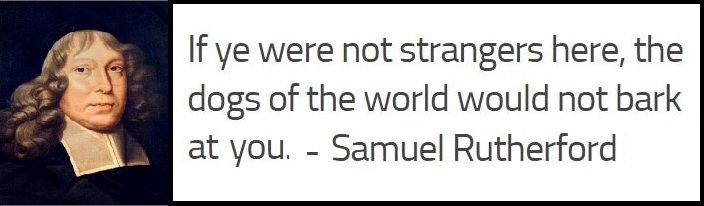
If ye were not strangers here - Samuel Rutherford


— If ye were not strangers here, the dogs of the world would not bark at you. You may see all windings and turnings that are in your way to heaven out of God's Word; for He will not lead you to the kingdom at the nearest, but you must go through "honour and dishonour, by evil report and good report; as deceivers, and yet true; as unknown, and yet well known; as dying, and, behold, we live; as chastened, and not killed; as sorrowful, and yet always rejoicing" (2 Cor. vi. 8, 10). The world is one of the enemies that we have to fight with, but a vanquished and overcome enemy, and like a beaten and forlorn soldier; for our ‪#‎Jesus‬ hath taken the armour from it. Let me then speak to you in His words: "Be of good courage," saith the Captain of our salvation, "for I have overcome the world."
— You shall neither be free of the scourge of the tongue, nor of disgraces (even if it were buffetings and spittings upon the face, as was our Saviour's case), if you follow Jesus Christ. I beseech you in the bowels of our Lord Jesus, keep a good conscience, as I trust you do. You live not upon men's opinion; gold may be gold, and have the king's stamp upon it, when it is trampled upon by men. Happy are you, if, when the world trampleth upon you in your credit and good name, yet you are the Lord's gold, stamped with the King of heaven's image, and sealed by the Spirit unto the day of your redemption. Pray for the spirit of love; for "love beareth all things; it believeth all things, hopeth all things, and endureth all things" (1 Cor. xiii. 7).
-Samuel Rutherford

Wednesday, June 24, 2015

Backslider - J.C. Ryle


"It is a miserable thing to be a backslider. Of all unhappy things that can befall a man, I suppose it is the worst. A stranded ship, a brokenwinged eagle, a garden overrun with weeds, a harp without strings, a church in ruins, all these are sad sights, but a backslider is a sadder sight still. A wounded conscience - a mind sick of itself - a memory full of self-reproach - a heart pierced through with the Lord's arrows - a spirit broken with a load of inward accusation - all this is a taste of hell. It is a hell on earth. Truly that saying of the wise man is solemn and weighty, "The backslider in heart shall be filled with his own ways" (Prov. 14:14)."
J.C. Ryle

Sunday, June 14, 2015

The great tragedy of mankind - A.W. Tozer


I know there are people who hear me preach regularly, who will never consider changing their way of living. They will go “underground” before they will do that! Our situation is not an isolated case. There are millions of men and women with an understanding of the revelation of God in Jesus Christ, who are still not willing to receive and commit themselves to Him whom the very angels and stars and rivers receive. They hesitate and they delay because they know God is asking the abdication of their own selfish little kingdom and interests. This is the tragedy of mankind, my brethren! We have rejected Him from our lives, because we must have our own way. But until Jesus Christ is sincerely received, there can be no knowledge of salvation nor any understanding of the things of God. The little, selfish, sinful man rejects the Son of God. While he is still enumerating the things he deserves, the Son of God stands outside.
My brethren, I repeat: this is the great tragedy of mankind! - A.W. Tozer

Friday, April 3, 2015

Pardon at the mercy-seat of Christ ~J.C. Ryle


Thousands and tens of thousands have sought for pardon at the mercy-seat of Christ, and not one has ever returned to say that he sought in vain. Sinners of every name and nation—sinners of every sort and description—have knocked at the door of the fold, and none have ever been refused admission.

If the way which the Gospel sets before us were a new and untraveled way—we might well feel faint-hearted. But it is not so. It is an old path. It is a path worn by the feet of many pilgrims, and a path in which the footsteps are all one way. The treasury of Christ's mercies has never been found empty. The well of living waters has never proved dry.

~J.C. Ryle

Wednesday, April 1, 2015

God shall wipe away all tears from their eyes - Matthew Henry


This new and blessed state will be free from all trouble and sorrow; for, 1. All the effects of former trouble shall be done away. They have been often before in tears, by reason of sin, of affliction, of the calamities of the church; but now all tears shall be wiped away; no signs, no remembrance of former sorrows shall remain, any further than to make their present felicity the greater. God himself, as their tender Father, with his own kind hand, shall wipe away the tears of his children; and they would not have been without those tears when God shall come and wipe them away. 2. All the causes of future sorrow shall be for ever removed: There shall be neither death nor pain; and therefore no sorrow nor crying; these are things incident to that state in which they were before, but now all former things have passed away. - Revelation 21:1-4


 Matthew Henry

Saturday, March 21, 2015

The supreme authority of the ‪Bible - J.C. Ryle


The supreme authority of the ‪Bible‬, in one word, is one of the cornerstones of our system. Show us anything plainly written in that Book, and, however trying to flesh and blood, we will receive it, believe it, and submit to it. Show us anything, as religion, which is contrary to that Book, and, however specious, plausible, beautiful, and apparently desirable, we will not have it at any price. It may come before us endorsed by Fathers, schoolmen, and catholic writers; it may be commended by reason, philosophy, science, the inner light, the verifying faculty, the universal conscience of mankind. It signifies nothing. Give us rather a few plain texts. If the thing is not in the Bible, deducible from the Bible, or in manifest harmony with the Bible, we will have none of it. Like the forbidden fruit, we dare not touch it, lest we die. Our faith can find no resting – place except in the Bible. Here is rock: all else is sand.

- J.C. Ryle

One second of glory will outweigh a lifetime of suffering. ~ A.W. PINK


One second of glory will outweigh a lifetime of suffering. What were the years of toil, of sickness, of battling with poverty, of sorrow in any or every form, when compared with the glory of Immanuel’s land! One draught of the river of pleasure at God’s right hand, one breath of Paradise, one hour amid the blood-washed around the throne, shall more than compensate for all the tears and groans of earth. “For I reckon that the sufferings of this present time are not worthy to be compared with the glory which shall be revealed in us.” May the Holy Spirit enable both writer and reader to lay hold of this with appropriating faith and live in the present possession and enjoyment of it to the praise of the glory of Divine grace. ~ A.W. PINK

Wednesday, March 4, 2015

A Plea to the Lost — Charles Spurgeon


"Remember, last of all that the Law which is so sharp and terrible to men when it only deals with them for their good, will, if you and I die without being brought to Christ, be much more terrible to us in eternity, when it deals with us in justice for our punishment! Then it will not be enshrined in the body of Moses, but, terrible to tell, it will be incarnate in the Person of the Son of God sitting upon the Throne!..He will be at once the Lawgiver, the Judge, and the Savior; and you that have despised Him as the Saviour will have to appear before Him as your Judge! And His Justice will be clear and undiluted now that His Mercy has been scorned! Oil is soft; but set it on fire and see how it burns! Love is sweet; but curdle it to jealousy and see how sour it is! ..If you turn the Lamb of Zion into the Lion of the tribe of Judah, beware, for He will tear you in pieces, and there shall be none to deliver you! Rejected love will change its hand. The pierced hands were stretched out with invitations of His Mercy; but if these are rejected!?..O Sinners, I am telling you the solemn Truth of God! Please hear it, I pray you, before I send you away! If from those hands that were pierced you will not take the perfect Salvation which He is prepared to give to all who confess their guilt, you will have to receive from those same hands the blows of that iron rod which shall break you in pieces as a potter’s vessel! Fly now and kiss the Son, lest He be angry, and you perish from the way while His Wrath is kindled but a little! Blessed are all they that put their trust in Him! Amen."


— Charles Spurgeon, A Plea to the Lost

Thursday, February 12, 2015

Martyn Lloyd-Jones Studies in the Sermon on the Mount


“If I know that I am ‘a debtor to mercy alone,’ if I know that I am a Christian solely because of that free grace of God, there should be no pride left in me, there should be nothing vindictive, there should be no insisting upon my rights. Rather, as I look out upon others, if there is anything in them that is unworthy, or that is a manifestation of sin, I should have this great sorrow for them in my heart. … We should feel a great sorrow for them, we should be praying to God for them and asking Him to have mercy upon them. I say that all this follows of necessity if we have truly experienced what it means to be forgiven.” - Martyn Lloyd-Jones

Thursday, February 5, 2015

"Christ, to the uttermost, has satisfied divine justice; the account is settled; the handwriting is nailed to the cross; the receipt is given, and we are debtors to God’s justice no longer."Thus out of love we seek to express our gratitude, thanksgiving, favor, and love back to God by striving to obey His Word in the power of the Spirit and the grace that He himself supplies. - Charles H. Spurgeon

"Christ, to the uttermost, has satisfied divine justice; the account is settled; the handwriting is nailed to the cross; the receipt is given, and we are debtors to God’s justice no longer."
Thus out of love we seek to express our gratitude, thanksgiving, favor, and love back to God by striving to obey His Word in the power of the Spirit and the grace that He himself supplies. - Charles H. Spurgeon

Wednesday, February 4, 2015

Can you not watch with Christ for one hour?" - William Gurnall


"Let this encourage those of you who belong to Christ: the storm may be tempestuous, but it is only temporary. The clouds that are temporarily rolling over your head will pass, and then you will have fair weather, an eternal sunshine of glory.

Can you not watch with Christ for one hour?" 
- William Gurnall

Friday, January 30, 2015

Do You Believe in the True Christ? - Tim Conway

To deny a doctrine or alter the work or person of Jesus Christ is to attack Christ and to deny the true Christ of the Bible. ‪

1 John 4:2-3 Hereby know ye the Spirit of God: Every spirit that confesseth that Jesus Christ is come in the flesh is of God: And every spirit that confesseth not that Jesus Christ is come in the flesh is not of God: and this is that spirit of antichrist, whereof ye have heard that it should come; and even now already is it in the world.


Wednesday, January 28, 2015

Gospel Treasures - by J.C. Ryle


I dare be sure this paper will be read by some one who feels that his sins are not yet forgiven. Reader, are you that man?


My heart’s desire and prayer to God is that you may seek forgiveness without delay. There is forgiveness in Jesus Christ for every one that is willing to receive it. There is every encouragement that your soul can need, to confess your sins and lay hold on this forgiveness this very day.


Reader, listen to me while I try to exhibit to you the treasure of Gospel forgiveness. I cannot describe its fullness as I ought. Its riches are indeed unsearchable (Eph. 3:8). But if you will turn away from it you shall not be able to say in the day of judgment, you did not at all know what it was.


Consider, then, for one thing, that the forgiveness set before you is a great and broad forgiveness. Hear what the Prince of Peace Himself declares: “All sins shall be forgiven unto the sons of men, and blasphemies wherewith soever they shall blaspheme” (Mark 3:28); “Though your sins be as scarlet, they shall become as white as snow; though they be red like crimson, they shall be as wool” (Isaiah 1:18). Yes! though your trespasses be more in number than the hairs of your head, the stars in heaven, the leaves of the forest, the blades of grass, the grains of sand on the sea shore, still they can all be pardoned. As the waters of Noah’s flood covered over and hid the tops of the highest hills, so can the blood of Jesus cover over and hide your mightiest sins. “His blood cleanseth from all sin” (1 John 1:7). Though to you they seem written with the point of a diamond, they can all be effaced from the book of God’s remembrance by that precious blood. Paul names a long list of abominations which the Corinthians had committed, and then says: “Such were some of you: but ye are washed” (1 Cor. 6:11).


Furthermore, it is a full and complete forgiveness. It is not like David’s pardon to Absalom,—a permission to return home, but not a full restoration to favour (2 Sam. 14:24). It is not, as some fancy, a mere letting off, and letting alone. It is a pardon so complete, that he who has it is reckoned as righteous as if he had never sinned at all. His iniquities are blotted out. They are removed from him as far as the east from the west (Psalm 103:12). There remains no condemnation for him. The Father sees him joined to Christ, and is well pleased. The Son beholds him clothed with ‘His own righteousness, and says, “Thou art all fair, … there is no spot in thee” (Cant. 4:7). Blessed be God that it is so. I verily believe if the best of us all had only one blot left for himself to wipe out, he would miss eternal life. If the holiest child of Adam were in heaven all but his little finger, and to get in depended on himself, I am sure he would never enter the kingdom. If Noah, Daniel, and Job had had but one day’s sin to wash away, they would never have been saved. Praised be God that in the matter of our pardon there is nothing left for man to do. Jesus does all, and man has only to hold out an empty hand and to receive.


Furthermore, it is a free and unconditional forgiveness. It is not burdened with an “if,” like Solomon’s pardon to Adonijah: “If he will show himself a worthy man” (1 Kings 1:52). Nor yet are you obliged to carry a price in your hand, or bring a character with you to prove yourself deserving of mercy. Jesus requires but one character, and that is that you should feel yourself a sinful, bad man. He invites you to “buy wine and milk without money and without price,” and declares, “Whosoever will, let him take the water of life freely” (Isaiah 55:1; Rev 22:17) ‘Like David in the cave of Adullam, He receives everyone that feels in distress and a debtor, and rejects none (1 Sam. 22:2). Are you a sinner? Do you want a Saviour? Then come to Jesus just as you are, and your soul shall live.


Again, it is an offered forgiveness I have read of earthly kings who knew not how to show mercy,—of Henry the Eighth of England, who spared neither man nor woman; of James the Fifth of Scotland, who would never show favour to a Douglas. The King of kings is not like them. He calls on man to come to Him, and be pardoned. “Unto you, O men, I call; and my voice is to the sons of men” (Prov. 8:4). “Ho, every one that thirsteth, come ye to the waters” (Isaiah 55:1) “If any man thirst, let him come unto Me and drink” (John 7:37). “Come unto Me, all ye that labour and are heavy laden, and I will give you rest” (Matt. 11:28). Oh, reader, it ought to be a great comfort to you and me to hear of any pardon at all; but to hear Jesus Himself inviting us, to see Jesus Himself holding out His hand to us,—the Saviour seeking the sinner before the sinner seeks the Saviour,—this is encouragement, this is strong consolation indeed!


Again, it is a willing forgiveness. I have heard of pardons granted in reply to long entreaty, and wrung out by much importunity. King Edward the Third of England would not spare the citizens of Calais till they came to him with halters round their necks, and his own Queen interceded for them on her knees. But Jesus is “good and ready to forgive” (Psalm 86:5). He delighteth in mercy (Micah 7:18) Judgment is His strange work. He is not willing that any should perish (2 Peter 3:9). He would fain have all men saved, and come to the knowledge of the truth (1 Tim. 2:4) He wept over unbelieving Jerusalem. “As I live;” He says, “I have no pleasure in the death of the wicked. Turn ye, turn ye, from your evil ways: why will ye die?” (Ezek. 33:11). Ah, reader, you and I may well come boldly to the throne of grace! He who sits there is far more willing and ready to give mercy than you and I are to receive it.


Besides this, it is a tried forgiveness. Thousands and tens of thousands have sought for pardon at the mercy-seat of Christ, and not one has ever returned to say that he sought in vain; sinners of every name and nation,—sinners of every sort and description, have knocked at the door of the fold, and none have ever been refused admission. Zacchæus the extortioner, Magdalene the harlot, Saul the persecutor, Peter the denier of his Lord, the Jews who crucified the Prince of Life, the idolatrous Athenians, the adulterous Corinthians,… —all have ventured their souls on Christ’s promises of pardon, and none have ever found them fail. Ah, reader, if the way I set before you were a new and untravelled way, you might well feel faint-hearted! But it is not so. It is an old path. It is a path worn by the feet of many pilgrims, and a path in which the footsteps are all one way. The treasury of Christ’s mercies has never been found empty. The well of living waters has never proved dry.


Beside this, it is a present forgiveness. All that believe in Jesus are at once justified from all things (Acts 13:39). The very day the younger son returned to his father’s house he was clothed with the best robe, had the ring put on his hand, and shoes on his feet (Luke 15). The very day Zacchæus received Jesus he heard these comfortable words “This day is salvation come to this house” (Luke 19:9). The very day that David said, “I have sinned against the Lord,” he was told by Nathan, “The Lord hath also put away thy sin” (2 Sam. 12:13). The very day you first flee to Christ, your sins are all removed. Your pardon is not a thing far away, to be obtained only after many years. It is nigh at hand. It is close to you, within your reach, all ready to be bestowed. Believe, and that very moment it is your own. “He that believeth is not condemned” (John 3:18). It is not said, “he shall not be,” or “will not be,” but “is not.” From the time of his believing, condemnation is gone. “He that believeth hath everlasting life” (John 3:36). It is not said, “he shall have,” or “will have,” it is “hath” It is his own as surely as if he was in heaven, though not so evidently so to his own eyes. Ah, reader, you must not think forgiveness will be nearer to a believer in the day of judgment than it was in the hour he first believed! His complete salvation from the power of sin is every year nearer and nearer to him; but as to his forgiveness and justification, it is a finished work from the very minute he first commits himself to Christ.


Last, and best of all, it is an everlasting forgiveness. It is not like Shimei’s pardon, a pardon that may sometime be revoked and taken away (1 Kings 2:9). Once justified you are justified forever. Once written down in the book of life, your name shall never be blotted out. The sins of God’s children are said to be cast into the depths of the sea,—to be sought for and not found,—to be remembered no more,—to be cast behind God’s back (Mic. 7:19; Jer. 50:20; 31:34; Isaiah 38:17). Some people fancy they may be justified one year and condemned another,—children of adoption at one time and strangers by and by,—heirs of the kingdom in the beginning of their days, and yet servants of the devil in their end. I cannot find this in the Bible. As the New Zealander told the Romish priest, “I do not see it in the Book.” It seems to me to overturn the good news of the Gospel altogether, and to tear up its comforts by the roots. I believe the salvation Jesus offers is an everlasting salvation, and a pardon once sealed with His blood shall never be reversed.


Reader, I have set before you the nature of the forgiveness offered to you. I have told you but little of it, for my words are weaker than my will. The half of it remains untold. The greatness of it is far more than any report of mine. But I think I have said enough to show you it is worth the seeking, and I can wish you nothing better than that you may strive to make it your own.

“Gospel Treasures!” by J.C. Ryle

Tuesday, January 27, 2015

J.C. Ryle – Our Love For Jesus Christ

Does the debtor in jail love the friend who unexpectedly and undeservedly pays all his debt, supplies him with fresh capital, and takes him into partnership with himself? Does the prisoner in war love the man who, at the risk of his own life, breaks through the enemies’ lines, rescues him and sets him free? Does the drowning sailor love the man who plunges into the sea, dives after him, catches him by the hair of his head and by a mighty effort saves him from a watery grave? A very child can answer such questions as these. Just in the same way, and upon the same principles, a true Christian loves Jesus Christ. - J.C. Ryle

Thursday, February 6, 2014

Thoughts on John's Gospel - J.C. Ryle


To wear material crosses as an ornament, to place material crosses on churches and tombs, all this is cheap and easy work, and entails no trouble. But to have Christ’s cross in our hearts, to carry Christ’s cross in our daily walk, to know the fellowship of His sufferings, to be made conformable to His death, to have crucified affections, and live crucified lives,— all this needs self-denial; and Christians of this stamp are few and far between. Yet, this, we may be sure, is the only cross-bearing and cross-carrying that does good in the world. The times require less of the cross outwardly and more of the cross within. - 

Thoughts on John Gospel Expositions by J.C. Ryle

Romans 8:38-39 Daily Walking With God - Octavius Winslow

“For I am persuaded, that neither death, nor life, nor angels, nor principalities, nor powers, nor things present, nor things to come...